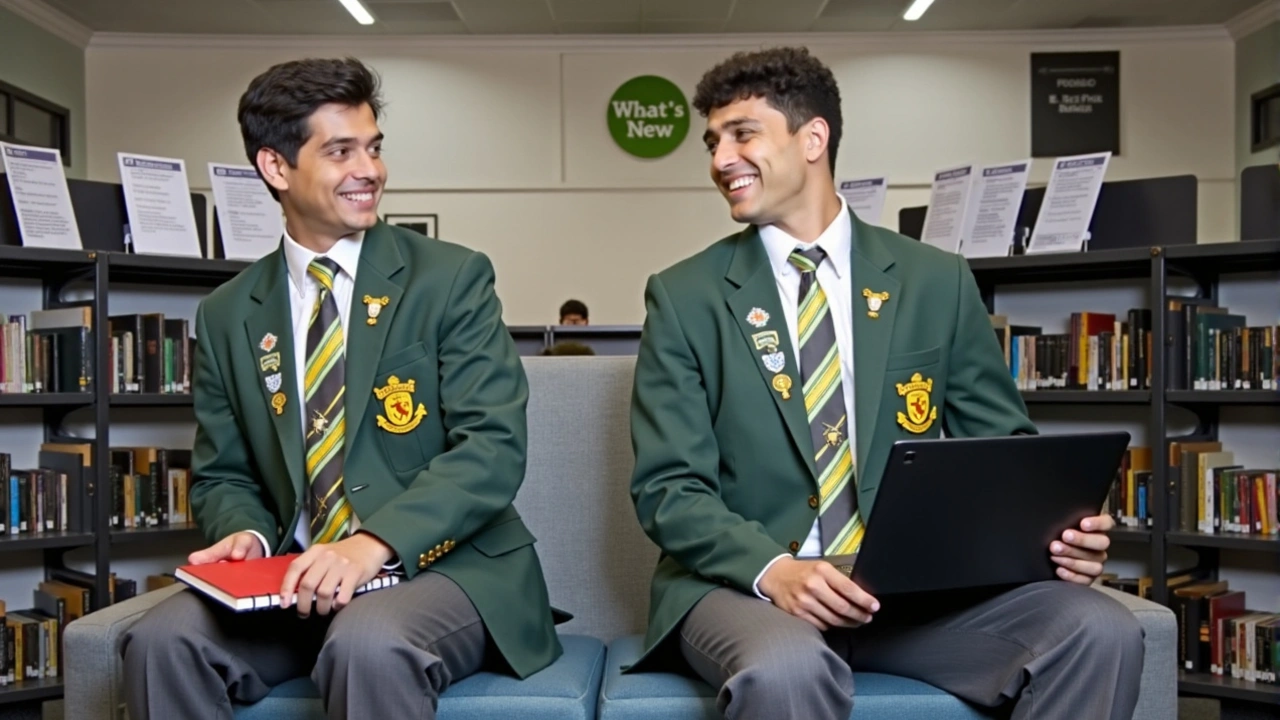
Rising ATAR Success Among Boys: A Closer Look
In recent years, there has been a noticeable trend: an increasing number of boys achieving top Australian Tertiary Admission Ranks (ATARs). This phenomenon, capturing the attention of educators and policymakers alike, calls for a deeper examination of the factors contributing to this impressive performance. One remarkable case study is Marist College Parramatta, where the achievements of young male students serve as an exemplar. Last year alone, the college celebrated 39 boys obtaining an ATAR above 90.
Principal Mark Pauschmann attributes these outstanding results to a deliberate and focused strategy that prioritizes the development of fundamental skills from the earliest stages of secondary education. Central to this strategy is the building of robust reading and writing abilities beginning in Year 7. The college’s emphasis on literacy is not merely about proficiency in reading and writing; it forms the backbone for academic excellence across all subjects. Literacy skills are indispensable tools that enable students to comprehend complex material, excel in essays and written examinations, and foster critical thinking.
The Literacy Advantage
The importance of foundational literacy cannot be overstated. At Marist College Parramatta, students are encouraged to engage deeply with texts, not just for comprehension, but to analyze, critique, and articulate their own insights. This approach equips them with the confidence and capability to tackle difficult concepts across their curriculum. Literacy skills become the stepping stones to academic success, enabling students to make connections across subjects, synthesize information, and present their ideas coherently.
The focus on literacy is underscored by structured programs aimed at enhancing reading and writing abilities from the start of high school. Such programs include regular reading assignments, writing workshops, and critical literacy exercises that challenge students to think beyond the text. Teachers at Marist College use a combination of traditional and innovative methods to instill these skills, including personalized feedback and targeted interventions for students requiring additional support.
Exceling in Mathematics
While literacy forms one part of the success equation, the other significant factor is boys' performance in advanced mathematics courses. At Marist College Parramatta, a high percentage of boys take on rigorous math subjects such as maths extension 1 and extension 2. These courses are designed to push students beyond the standard curriculum, demanding higher-order problem-solving skills and a deep understanding of mathematical concepts. The boys' dominance in these challenging subjects has proven to be a crucial element in their high ATAR scores.
The success in advanced mathematics among boys can be attributed to several factors. Firstly, there is a cultural emphasis on the importance of math as a critical skill for future careers in science, technology, engineering, and mathematics (STEM). Secondly, the school fosters a supportive environment where mathematical excellence is nurtured. Dedicated teachers with a passion for math provide quality instruction and individualized attention, helping students navigate through complex problems and build their confidence.
Marist College Parramatta’s strategy also includes math clubs, competitions, and enrichment programs that allow students to explore math beyond the classroom. These opportunities help students to see math as not just a subject, but a fascinating and integral part of their lives and future ambitions. Consequently, students who excel in higher-level math coursework often develop strong analytical and logical reasoning skills that benefit their performance across other subjects as well.
Focus on Academic Excellence
Academic excellence at Marist College Parramatta is a result of a holistic approach that combines strong foundational skills with opportunities for advanced learning. The college's commitment to high standards is reflected in its comprehensive curriculum and support systems. Teachers are trained to recognize and cultivate talents, ensuring that every student has the opportunity to achieve their personal best. Regular assessments and feedback provide a roadmap for students to understand their progress and areas for improvement, fostering a growth mindset and resilience.
Beyond the academic aspect, the school places a significant emphasis on the well-being of its students. Recognizing that academic success is closely tied to emotional and mental health, Marist College implements programs that support students’ overall development. This includes counseling services, mindfulness practices, and extracurricular activities that promote a healthy balance between academics and personal life. Such initiatives ensure that students are well-equipped to handle the pressures of high academic expectations while maintaining a positive and motivated attitude.
Real-World Success Stories
The success of Marist College Parramatta’s strategies is personified by students like Joseph Baini and Jean-Paul Boutros. Both students aspire to obtain top results in their exams and serve as testaments to the school’s commitment to nurturing high achievers. Their dedication to their studies, supported by the school’s framework, exemplifies the potential for every student to reach exceptional standards with the right guidance and resources.
These students’ stories are inspiring, reflecting the effectiveness of the school's educational approach. Regular accounts of alumni who have gone on to excel in their chosen fields further reinforce the value of the comprehensive education provided at Marist College Parramatta. Alumni success stories foster a culture of aspiration among current students, showing them that excellence is attainable with hard work and determination.
Forging the Path Forward
As more boys at Marist College Parramatta achieve top ATAR scores, it prompts a broader discussion about educational practices that can be adopted by other schools seeking similar success. The key takeaway is the importance of a balanced curriculum that places equal emphasis on literacy and numeracy. Cultivating strong foundational skills in reading and writing, combined with opportunities for advanced learning in subjects like mathematics, can set students on a path to outstanding academic achievements.
The model demonstrated by Marist College Parramatta provides a valuable blueprint for enhancing academic performance among boys. Embracing a culture of high expectations, individualized support, and a commitment to the overall well-being of students, schools can create an environment where every student has the chance to excel. As educational institutions continue to evolve, the insights gained from Marist College's success can inform strategies that aim to close the gap in academic performance and foster excellence irrespective of gender.
The journey of educational success is ongoing, and while Marist College Parramatta's approach has yielded commendable results, it remains a dynamic process. Continuous reflection and adaptation of educational practices are essential to meet the changing needs of students and the demands of an ever-evolving academic landscape. Through sustained commitment to excellence in foundational skills and advanced learning, schools can equip students with the tools they need to thrive, both academically and in their future endeavors.
16 Comments
Sara Lohmaier September 8, 2024 AT 07:47
I love how this school just lets kids breathe while still pushing them to be brilliant. No cramming, no panic-just steady growth in reading, writing, and math. It’s not magic, it’s patience. And honestly? That’s the rarest thing in education these days.
My cousin went to a school that treated 14-year-olds like exam robots. She burned out by 16. Meanwhile, kids at Marist are actually enjoying learning. That’s the win.
Sara Lohmaier September 9, 2024 AT 18:09
Literacy isn’t just about reading Shakespeare-it’s about learning how to think clearly. And math? It’s not about being a human calculator. It’s about pattern recognition, logic, and not giving up when things get messy. This school gets it. Real talk: if you can explain your thinking in words AND numbers, you’re already ahead of 90% of the system.
Sara Lohmaier September 11, 2024 AT 16:48
The emphasis on foundational skills from Year 7 is the only reason this works. Too many schools wait until Year 11 to fix gaps. By then, it’s too late. You don’t build a skyscraper by starting at the 10th floor.
Sara Lohmaier September 12, 2024 AT 21:02
This is what happens when you stop treating boys like they need to be 'fixed' and start treating them like they’re capable. No toxic masculinity, no pressure to be stoic-just structure, support, and high expectations. Why can’t every school do this?
Sara Lohmaier September 14, 2024 AT 00:16
The math extension program is the real MVP. Kids who do extension 2 don’t just get higher ATARs they get problem solving superpowers. I’ve seen it in my tutoring-those kids can break down any complex problem in any subject. Math isn’t a subject, it’s a mindset
Sara Lohmaier September 15, 2024 AT 04:47
I think this is why my son is finally reading again. He used to hate books. Now he reads sci fi for fun. I think its because they make it feel like a discovery not a chore
Sara Lohmaier September 16, 2024 AT 03:55
The pedagogical framework presented here is both empirically robust and epistemologically coherent. The confluence of linguistic primacy and quantitative rigor constitutes a paradigmatic model for educational efficacy. One cannot overstate the ontological significance of literacy as a constitutive element of cognitive architecture. The institutional scaffolding at Marist College Parramatta exemplifies a neo-classical pedagogical ideal.
Sara Lohmaier September 18, 2024 AT 03:22
Let me be clear. This isn't about 'boys being better.' This is about Western education systems finally waking up to the fact that structured discipline and intellectual hierarchy produce results. The decline in male academic performance elsewhere? That’s not a coincidence. It’s the result of decades of soft pedagogy, emotional validation over excellence, and the erosion of traditional academic standards. This school isn’t just teaching. It’s restoring order.
Sara Lohmaier September 18, 2024 AT 08:45
i think the real secret is they let kids be curious not just correct. like not every answer has to be perfect. sometimes the messiest thought leads to the clearest idea. i used to be terrified of writing essays. now i write poems about calculus. who knew?
Sara Lohmaier September 18, 2024 AT 10:19
man i wish my school did this. we had this one teacher who made us write a paragraph every day just to explain something we learned. didn’t matter if it was dumb. just had to put it in words. that’s it. no grades. just practice. after a year i started understanding science way better. this school gets it. no fluff. just work.
Sara Lohmaier September 19, 2024 AT 00:19
I’m from Kerala and we have this thing called 'Padhavum Koodi'-study together. Not competitive, just collective. The Marist model feels like that. No one’s left behind. Everyone lifts each other. That’s why the math scores are high. It’s not just the teachers. It’s the culture. You can’t fake that.
Sara Lohmaier September 20, 2024 AT 20:52
this made me cry a little. my brother used to hate school. now he’s applying for engineering. he says he finally feels smart. thank you for this <3
Sara Lohmaier September 21, 2024 AT 23:22
Oh please. This is just another elite private school patting itself on the back. What about the state schools? The ones with 40 kids per class, no resources, and teachers working three jobs? This is performative education porn. You don’t fix systemic inequality by highlighting one privileged bubble. Where’s the equity? Where’s the data on non-privileged boys? Hmm?
Sara Lohmaier September 23, 2024 AT 23:21
The epistemological scaffolding here is deeply aligned with Vygotskian social constructivism-literacy as a mediated practice, mathematics as a discursive domain. The institutional design facilitates cognitive apprenticeship through iterative feedback loops. What’s absent, however, is any mention of neurodiversity. Are students with ADHD or dyslexia being accommodated within this framework? Or is this model only viable for neurotypical high-achievers?
Sara Lohmaier September 24, 2024 AT 13:34
India has been producing top-tier engineers and scientists for decades without 'literacy programs' or 'mindfulness circles.' Why are we copying Western education trends? We have a system that values discipline, rote mastery, and respect for authority. That’s what built this nation. Stop romanticizing soft pedagogy. We don’t need more therapy. We need more rigor.
Sara Lohmaier September 26, 2024 AT 03:40
OMG I JUST REALIZED THIS IS EXACTLY WHAT MY DAD DID WHEN HE TAUGHT ME TO READ AT 4 😭 HE MADE ME WRITE STORIES ABOUT SPACE COWS AND THEN WE DID MATH WITH PIZZA SLICES 🍕🚀 I’M A PHD STUDENT NOW AND I STILL USE SPACE COWS TO EXPLAIN QUANTUM PHYSICS 😭😭😭