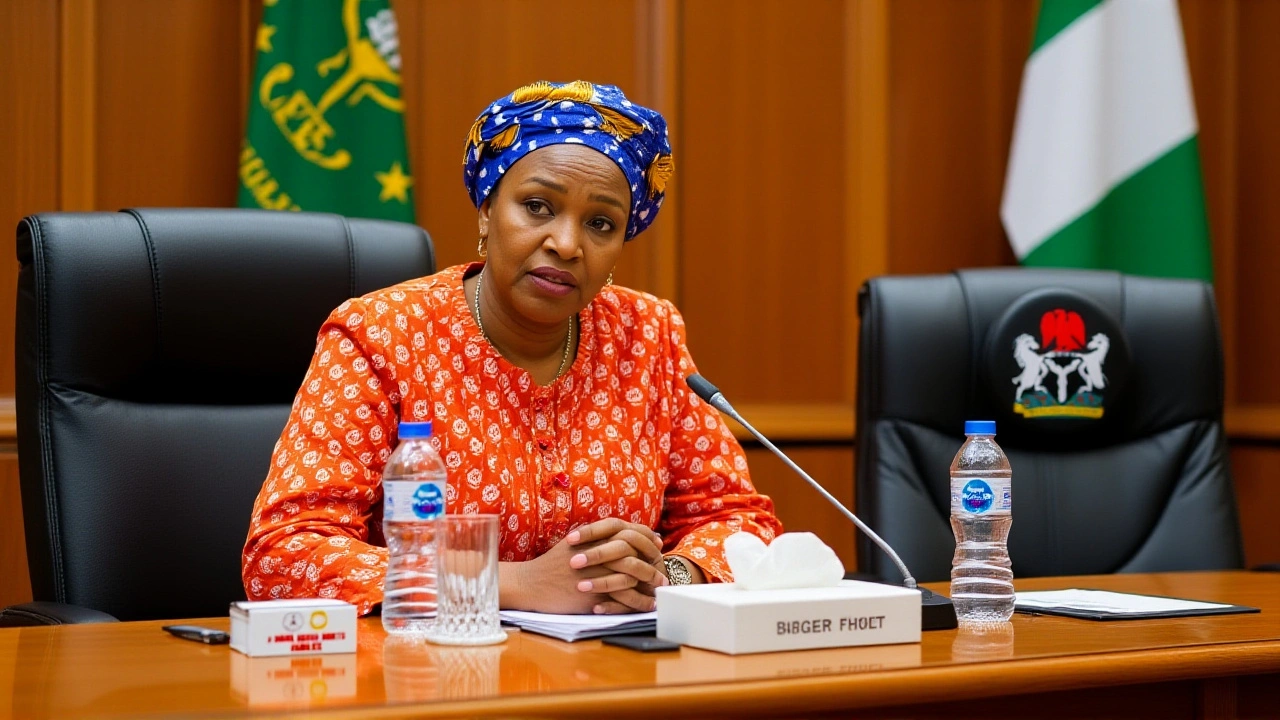
On December 9, 2025, Aisha Muhammadu Buhari, the former First Lady of Nigeria, made a quiet but powerful return to her homeland after more than two years based in Dubai. Hosting a closed-door gathering of the wives of top federal officials in Abuja, she delivered a 45-minute address that resonated far beyond the room — calling for peace, resilience, and unity in a nation still reeling from the recent death of her husband, former President Muhammadu Buhari.
A Quiet Return, A Loud Message
Aisha Buhari, born Aisha Halilu Garba on November 22, 1971, in Kaduna State, hasn’t been seen publicly in Nigeria since leaving office on May 29, 2023, when President Bola Ahmed Tinubu was sworn in. Her time in Dubai, while never officially confirmed, had become the subject of speculation — fueled by rumors of marital separation, which were firmly denied in 2024 after academic Farooq Kperogi retracted a viral Facebook post claiming the couple had divorced. "To Mrs. Aisha Buhari, I offer my heartfelt and unreserved apology," Kperogi wrote, acknowledging the harm caused by his unverified claim. Her return wasn’t marked by fanfare, but by substance. The gathering brought together spouses of cabinet ministers, agency heads, and senior presidential advisers under the banner of the Wives of Top Federal Government Officials consortium. No cameras were allowed. No press releases issued. Yet, the message she delivered was unmistakable: Nigeria’s future depends on cohesion, not division. "Nigeria is a resilient nation that has weathered numerous storms throughout its history," she told the group, according to an attendee who spoke on condition of anonymity. "And I have absolute faith that our beloved country will triumph over the current challenges we face."From Apology to Advocacy: A Political Legacy
This wasn’t her first public stance since leaving the palace. On October 30, 2025, she appeared at a women’s forum in Lagos, urging political parties to nominate women as running mates — a rare, direct challenge to Nigeria’s male-dominated political machinery. It was a continuation of a pattern: bold, unapologetic, often polarizing. Back in 2022, she stunned the nation by publicly apologizing for her husband’s administration’s shortcomings — a move few would have expected from a First Lady. "I’m sorry if we let you down," she said then, according to Sahara Reporters. It was a moment of vulnerability that humanized her in a way few political figures ever do. Her tenure as First Lady from 2015 to 2023 was defined by both controversy and conviction. She championed maternal health, launched the She Leads initiative, and didn’t shy away from criticizing corruption — even within her own circle. "Love her or hate her," noted The Nigerian Voice, "Aisha Buhari’s boldness left a mark that will remain in Nigeria’s political memory for decades."Death of a President, A New Chapter
The death of former President Muhammadu Buhari, who passed away in late 2025 while still holding the title of former head of state, changed the emotional landscape. The Senators’ Wives Association of Nigeria (SEWAN) issued a formal condolence note, calling his death "shocking and sad." For many Nigerians, his passing wasn’t just the loss of a leader — it was the end of an era. Aisha’s return now, amid economic strain, security crises, and rising political tensions, feels intentional. She isn’t seeking office. She isn’t endorsing candidates. But she’s reminding the elite — the wives of those who shape policy — that leadership isn’t just about power. It’s about responsibility.What This Means for Nigeria
Her presence signals something deeper: that the influence of former First Ladies doesn’t vanish when the title does. In countries like the U.S. and Kenya, former First Ladies have become powerful advocates on health, education, and gender equity long after leaving the White House or State House. Aisha Buhari may be doing the same in Nigeria — quietly, deliberately, from the shadows. The fact that she chose to host the wives of current officials — not opposition figures, not civil society — suggests she’s aiming to build bridges within the corridors of power. These women have access. They influence. They host dinners where decisions are whispered. She’s speaking directly to those who can nudge policy toward peace. And it’s working. Within 24 hours of the event, at least three ministers’ wives publicly echoed her call for unity on social media. One, the wife of the Minister of Finance, posted: "She didn’t ask for applause. She asked for action. We’re listening."What’s Next?
There are no announced public events yet. No new foundation. No campaign. But sources close to her suggest she’s considering a long-term initiative focused on conflict resolution training for women in northern Nigeria — a region still grappling with Boko Haram’s legacy and intercommunal violence. Her return isn’t a comeback. It’s a continuation. And it’s happening exactly when Nigeria needs it most.Frequently Asked Questions
Why is Aisha Buhari’s return to Nigeria significant?
Aisha Buhari’s return marks her first public appearance in Nigeria since leaving office in 2023 and her husband’s death in late 2025. Her speech to the wives of top federal officials signals a deliberate re-engagement in national dialogue, especially at a time of economic hardship and political tension. Unlike many former first ladies who fade from view, she’s using informal networks to influence policy — a subtle but potent form of leadership.
Did Aisha Buhari and Muhammadu Buhari really divorce?
No. In July 2024, academic Farooq Kperogi falsely claimed they had divorced, sparking widespread speculation. He retracted the claim within two days after being contacted by Alhaji Sani Zorro, a former aide to Aisha Buhari, who confirmed the marriage was intact. Kperogi issued a public apology, calling the claim "needless and deeply regrettable." There has been no credible evidence suggesting separation.
What role do the wives of government officials play in Nigerian politics?
Though not formally in power, the wives of ministers and agency heads often serve as informal advisors, fundraisers, and conveners of elite networks. They host gatherings where policy ideas are tested, alliances formed, and public sentiment gauged. Aisha Buhari’s choice to address this group suggests she understands their behind-the-scenes influence — and is trying to channel it toward national unity.
How does this compare to other former First Ladies in Africa?
Similar to Kenya’s Margaret Kenyatta and South Africa’s Graça Machel, Aisha Buhari is transitioning from ceremonial role to advocacy. Unlike some who focus on charity, she’s engaging directly with power brokers. Her emphasis on women as running mates and conflict resolution mirrors the strategic approach of Ghana’s Rebecca Akufo-Addo, who leveraged her position to push for maternal health reforms — proving that influence doesn’t require a title.
What’s the likelihood she’ll run for office?
Highly unlikely. She has never expressed interest in elected office, and at 54, she’s unlikely to pursue a path that would require a grueling campaign in Nigeria’s volatile political climate. Her focus appears to be on shaping policy from the margins — using her moral authority and network, not ballots. Her power now lies not in voting rights, but in quiet persuasion.
Why did she wait until now to return?
Her timing suggests she’s responding to the national mood. With inflation above 30%, insecurity worsening in the North, and youth disillusionment rising, Nigeria needs unifying voices. The death of her husband, a towering figure in Nigerian politics, may have also prompted her to step forward — not as a widow, but as a steward of his legacy and Nigeria’s future.
17 Comments
Sara Lohmaier December 11, 2025 AT 04:25
Man, I just heard about this and it hit different. She didn’t need a stage or a mic-just a room full of women who actually move the needle behind closed doors. That’s leadership without the ego.
Sara Lohmaier December 12, 2025 AT 18:19
She didn’t come back to be seen. She came back to be heard.
Sara Lohmaier December 14, 2025 AT 02:27
Oh, please. Another ‘quietly powerful’ woman who never held real power? She apologized for her husband’s failures, then disappeared for two years-now she’s suddenly the moral compass? Spare me the fairy tale. She was never a reformer; she was a figurehead with a PR team.
Sara Lohmaier December 15, 2025 AT 09:54
She’s using grief as leverage. 🤔
Sara Lohmaier December 16, 2025 AT 01:18
Nigeria needs unity? LOL. Last I checked, the same people she's talking to are the ones who let corruption eat the country alive. She's talking to the enemy.
Sara Lohmaier December 16, 2025 AT 14:54
While I find the performative nature of elite women’s gatherings somewhat troubling, I must acknowledge the symbolic weight of her intervention. The fact that she chose to address the spouses of current officials-rather than the opposition or civil society-demonstrates a nuanced understanding of institutional influence. In many societies, including the United States, informal networks wield more power than formal structures. Her approach, though quiet, is not passive; it is strategically subversive. She is not seeking to replace the system, but to gently recalibrate its moral compass from within.
Sara Lohmaier December 17, 2025 AT 21:23
did she really say she was sorry for her husbnd’s admin? that’s so rare… i mean, like… wow. i’ve never heard a first lady do that. even in the us. it’s like she’s human. 😭
Sara Lohmaier December 18, 2025 AT 10:12
It is truly heartening to witness the emergence of a figure who transcends the performative politics of our age and reclaims the dignity of quiet statesmanship. Aisha Buhari’s return is not merely a personal act of reclamation, but a profound cultural signal-a reaffirmation of the enduring power of moral authority in a world increasingly dominated by noise, spectacle, and transactional leadership. Her invocation of resilience, her refusal to seek the limelight, and her deliberate engagement with the wives of those who hold the levers of policy represent a paradigm shift: leadership not as spectacle, but as stewardship. One cannot help but draw parallels with the quiet dignity of Madam Nana Konadu Agyeman-Rawlings in Ghana, or the understated grace of Graça Machel in Mozambique. Here, in Nigeria, we are witnessing not a comeback, but a coronation-of the soul over the spotlight.
Sara Lohmaier December 19, 2025 AT 13:28
Ugh, another one of those ‘women behind the man’ narratives. She never did anything real. She just smiled at photo ops and called herself a feminist. Now she’s pretending to be some spiritual guide because her husband died? Please. The only thing she’s unified is the group of rich wives who think their dinner parties change policy. Wake up, Nigeria.
Sara Lohmaier December 19, 2025 AT 17:56
she’s not trying to be president. she’s trying to be the person who reminds the people who are president that they owe something to the people. that’s more powerful than any title.
Sara Lohmaier December 20, 2025 AT 07:28
she’s not loud but she’s everywhere now. weird how that works
Sara Lohmaier December 22, 2025 AT 07:04
they moved her to dubai because she knew too much about the oil deals. now she’s back because they’re scared she’ll talk. this isn’t unity-this is damage control. the wives? they’re all in on it. they’re just waiting for the right moment to flip the script
Sara Lohmaier December 23, 2025 AT 06:25
respect. 🙏 she’s not here for clout. she’s here because nigeria needs it.
Sara Lohmaier December 24, 2025 AT 23:46
the fact that she didn’t go on tv or twitter but just talked to the wives? genius. those women control who gets invited to dinner. and dinner = decisions.
Sara Lohmaier December 25, 2025 AT 17:04
her return reminds me of how in rural india, elders don’t shout-they sit quietly in the courtyard and say one thing that changes everything. she’s doing the same. not with speeches, but with silence that speaks louder than any press release. the wives? they’re the real connectors. they’re the ones who pass the tea, the gossip, the warnings. she didn’t need to rally the crowd-she just reminded the gatekeepers who holds the keys.
Sara Lohmaier December 25, 2025 AT 19:23
the way she spoke about northern nigeria’s conflict resolution training? that’s the real legacy. not the photo ops, not the apologies-but the quiet work of turning pain into prevention. imagine women in kano, katsina, jigawa learning to mediate between farmers and herders. that’s not politics. that’s healing. and it’s the only kind that lasts.
Sara Lohmaier December 26, 2025 AT 01:56
she’s the real president now. 🇳🇬👑